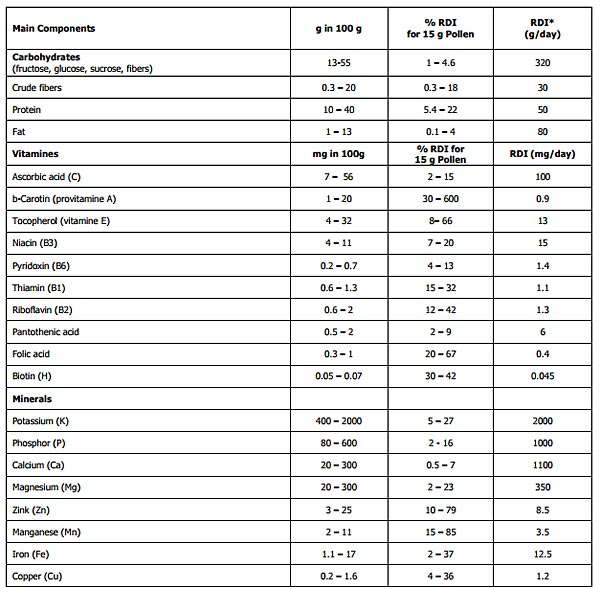
It contains high concentrations of reducing sugars, essential amino acids and unsaturated/saturated fatty acids, minerals as Zn, Cu, Fe, and high K/Na ratio and significant quantities of several vitamins: provitamin A, vitamin E (tocopherol), niacin, thiamine, folic acid and biotin.
The main biologically active compounds are the flavonoids and the phytosterols. Only about 3% of the total lipids are free fatty acid, about half of them are the unsaturated acids oleic, linoleic (omega-6) and linolenic (omega-3) (Stanley and Linskens, 1974). Other physiologically important compounds are the sterols. There is a significant nutritional contribution from most of the vitamines present in pollen: provitamine A, vitamine E (tocopherol), niaccin, thiamine, folic acids and biotin. Bee pollen contains also relatively high amounts of polyphenols and the flavonoids are the main compounds, most of them occur in pollen as glycosides (Stanley and Linskens, 1974; Markham & Campos, 1996). In one study it varied between 1293 and 8243 mg/100 g, in another, between 530 and 3258 mg/100 g.
One of the components responsible for antiprostatitic activity is quercetin and this is also one of the main flavonoids in bee pollen. Kaempferol, another bee pollen flavonoid. Besides cholesterol other sterols in pollen are fucosterol, beta-sitosterol, stigmasterol and campesterol.
Full article