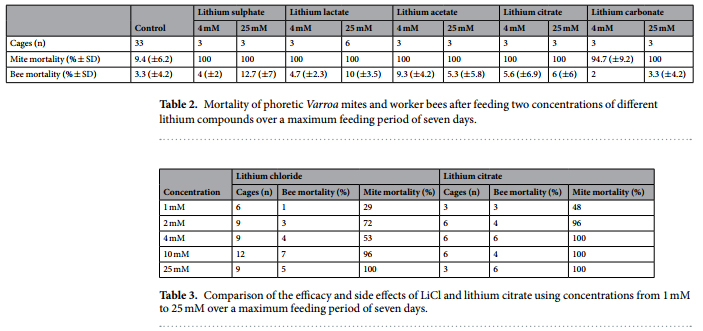
Efective concentration of lithium chloride. To corroborate the primary observations of our pilot study, we established cage experiments with diferent concentrations of LiCl for robust statistical analysis. In addition to the 25mM concentration, which was found to be efective in the pilot study, we used concentrations of 2mM, 4mM and 10mM in order to determine the lower threshold of efcacy. Te results supported the fndings of the previous study and demonstrated signifcant miticidal efects for LiCl concentrations as low as 2mM at which a substantial increase in mite mortality (P<0.001, log-rank test; Supplementary Table S2) was shown. Higher concentrations of 10 mM and 25 mM both signifcantly enhanced mite mortality starting at day two of treatment and achieved extermination of more than 96% of the treated mites at the end of the experiment (Fig. 1a, Supplementary Table S2). In the control experiments without LiCl in the feeding solution, mite mortality reached on average 9.3% and was therefore well within the range of mortality rates obtained for mites kept on untreated cage bees under diferent environmental conditions. Based on these results, we confrmed a clear efect of LiCl on mite viability in a concentration range between 2mM and 25mM.
Note*:
4mM/L = 300mg/L of Lithium Carbonate (LI2CO3)
10mM/L = 738mg/L of Lithium Carbonate (LI2CO3)
10mM/L = 423mg/L of Lithium Chloride (LiCl)
20mM/L = 340mg/L of Lithium Orotate(C5H3LiN2O4)
Lithium orotate contain 3.83 mg of elemental lithium per 100 mg and lithium carbonate contain 18.8 mg of elemental lithium per 100 mg
Full article
Lithium Chloride.pdf (4.88 mb)